
Reconfigurable Approximate Computing for Physical AI - Efficient and resilient edge intelligence
Date:
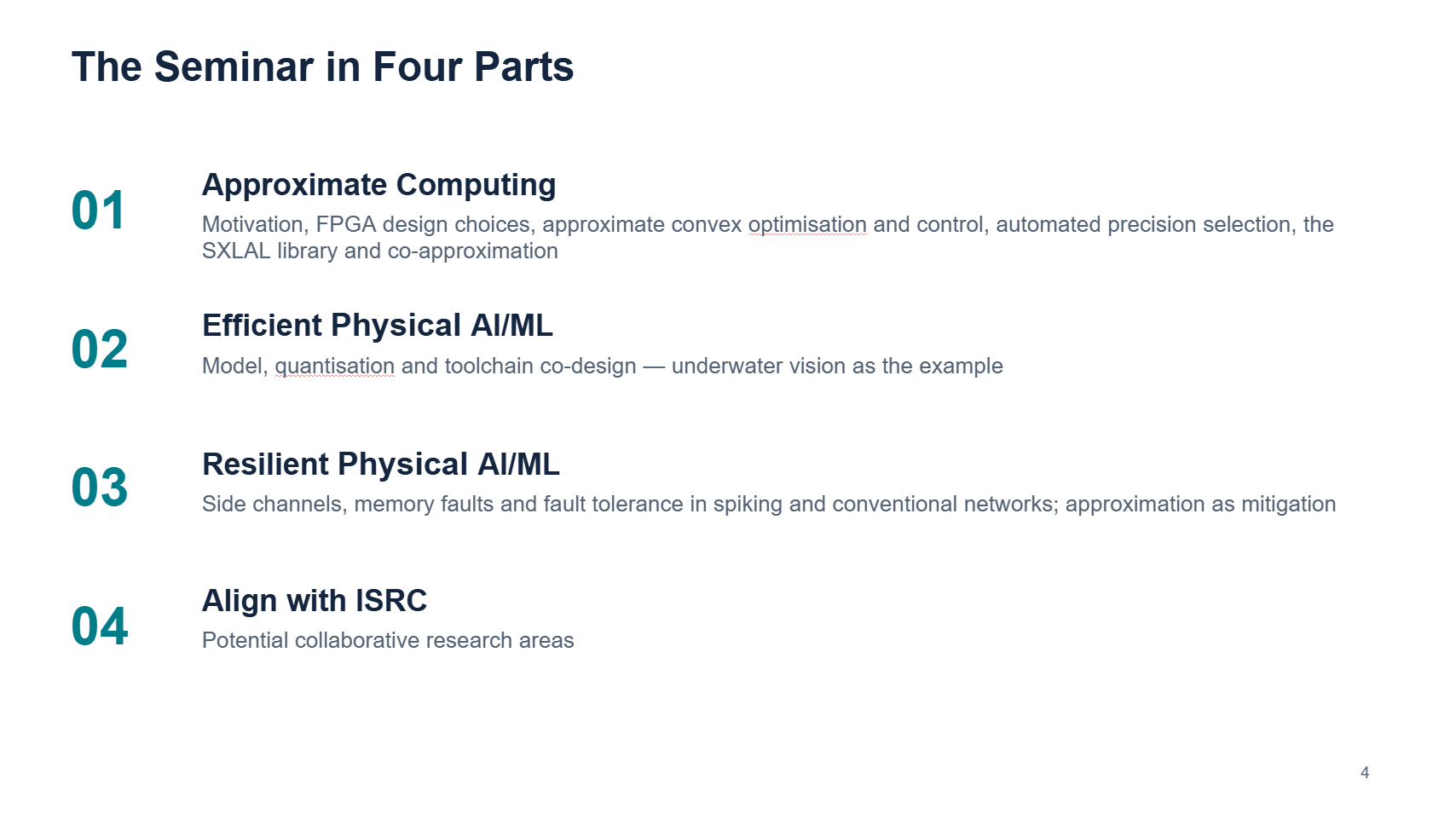
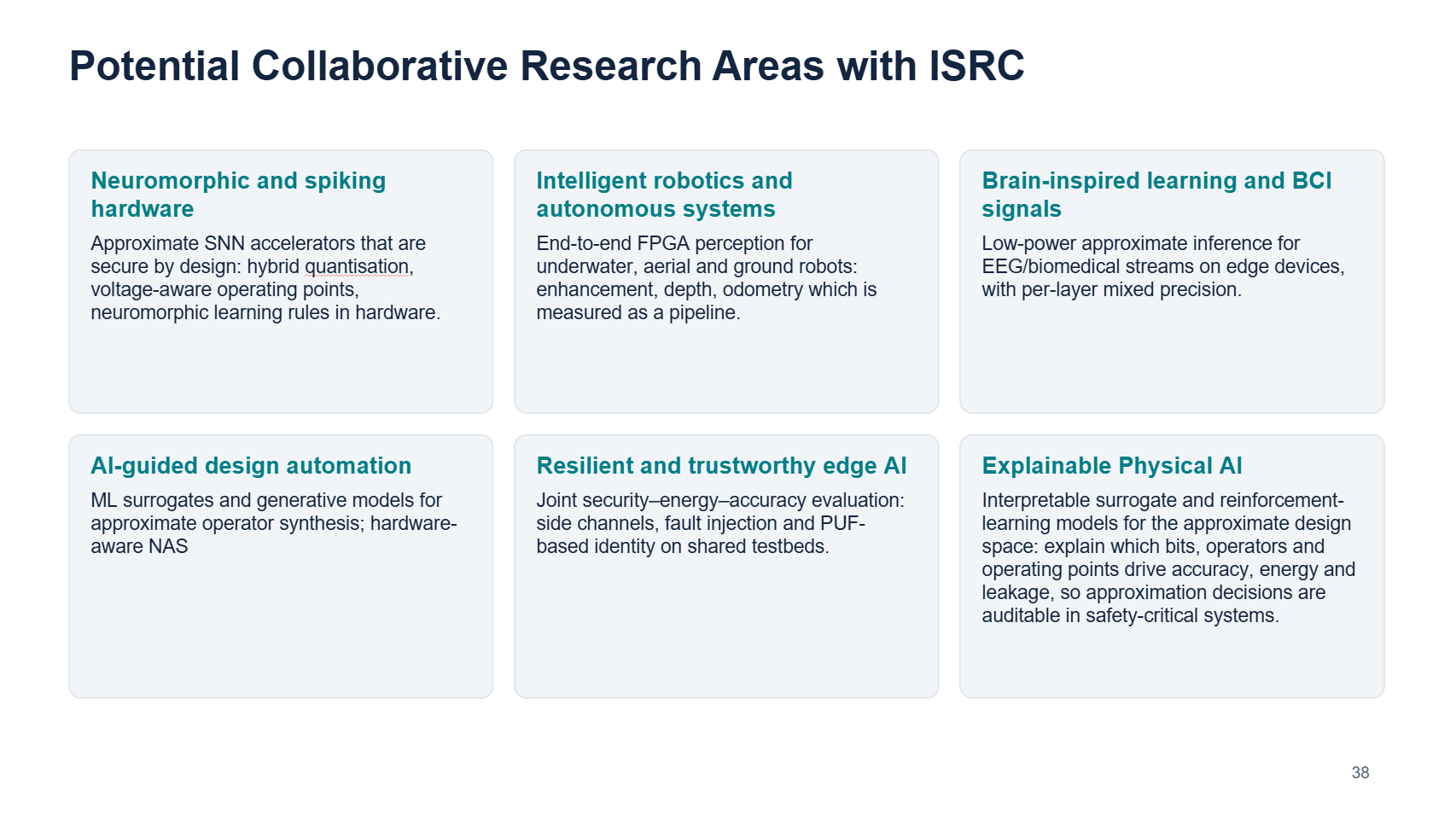
This seminar, Reconfigurable Approximate Computing for Physical AI, explores how approximate computing and reconfigurable hardware can enable efficient, resilient and trustworthy AI on resource-constrained edge platforms, including autonomous robots, underwater vehicles and spacecraft. It presents research on automated numerical precision selection, approximate optimisation and control, and hardware–software co-design, demonstrating significant improvements in energy efficiency, performance and resource utilisation while maintaining acceptable application accuracy. Using underwater image enhancement as a case study, the talk demonstrates how quantisation-aware training, custom neural network operators and FPGA acceleration can support efficient edge intelligence. Beyond conventional power, performance and area optimisation, it investigates how approximation affects hardware security and reliability, particularly side-channel leakage, memory faults and fault tolerance. The seminar concludes by highlighting opportunities for adaptive, application-aware computing that jointly optimises computational efficiency, accuracy, security and resilience, alongside potential collaborations in neuromorphic computing, autonomous systems, AI-driven hardware design and explainable AI.